
 German (DE)
  English (US)
  Spanish (ES)
  French (FR)
  Hindi (IN)
  Italian (IT)
  Portuguese (BR)
  Russian (RU)
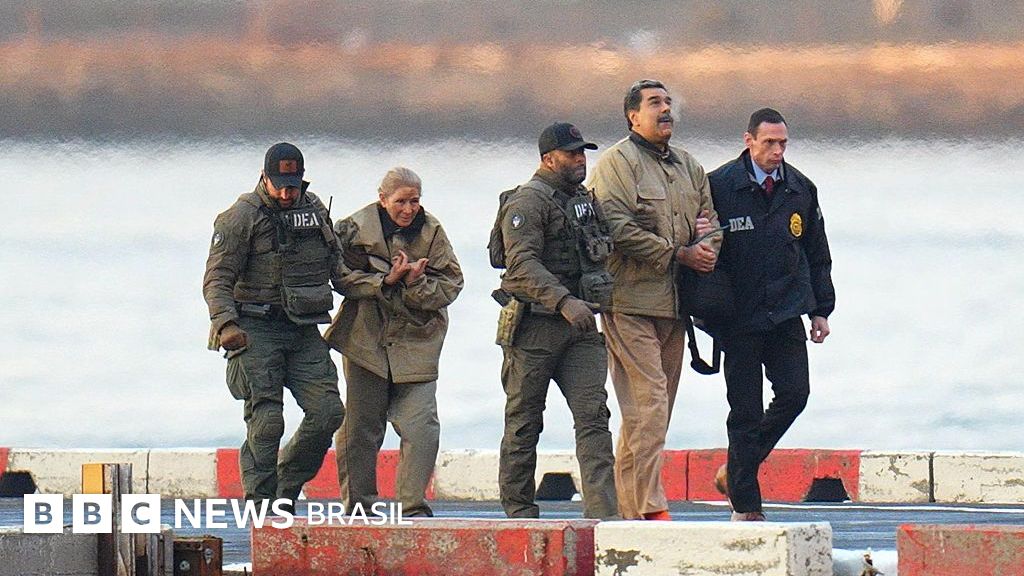
 The CIA conducted the first known U.S. attack on Venezuelan territory when it carried out a drone strike on a port facility in Venezuela last week, a government official familiar with the operation told The Intercept. The strike marks a new escalation of the Trump administration’s campaign against President Nicolás Maduro’s government, which has included dozens of attacks on supposed drug smuggling boats. A separate U.S. strike on Monday killed two alleged “narco-terrorists” in the Pacific Ocean.
The December 24 drone strike hit a dock that U.S. officials believe was used by members of Tren de Aragua, a Venezuelan gang. No people were on the dock at the time of the attack and no one was killed, according to the official. The details of the strike, which were first reported by CNN, offer a clearer picture of an attack first disclosed by President Donald Trump in a series of vague statements over several days.
“Now we’re going after the land,” Trump said during a Christmas Eve phone call to troops aboard the USS Gerald R. Ford, which is deployed to the Caribbean Sea as part of the campaign against Maduro. “They have a big plant or a big facility where the ships come from,” Trump then told John Catsimatidis, a billionaire and Trump donor who owns New York’s WABC radio station, on Friday. “Two nights ago, we knocked that out. We hit them very hard.”
On Monday, Trump provided more detail, explaining that the United States had “hit” an “implementation area” in Venezuela. “There was a major explosion in the dock area where they load the boats up with drugs,” Trump told reporters at his residence in Mar-a-Lago, Florida. “That’s where they implement, and that is no longer around.”
“This is the lawless Trump administration in action.”
Trump has publicly acknowledged he authorized CIA operations in Venezuela. Asked if the CIA had carried out the Christmas Eve attack, Trump said: “I don’t want to say that.”
The government official, who spoke with The Intercept on the condition of anonymity to discuss classified information, said they had been briefed on the CIA’s role in the attack.
A spokesperson writing from a CIA email and identified only as Ryan declined to comment on the Christmas Eve strike in an email to The Intercept.
“Days after it took place, the U.S. public is finally learning about a CIA airstrike on foreign soil for which there is no legal justification or congressional authorization. This is the lawless Trump administration in action,” Win Without War policy director Sam Ratner told The Intercept. “The only way forward is for Congress to stop Trump’s illegal strikes and hold those in the administration who have so flagrantly broken the law to account.”
The CIA regularly conducted drone strikes during the early years of the War on Terror, beginning in Yemen in 2002 and in Pakistan in 2004. During the Obama administration, the U.S. military largely took over such attacks, and since then, the armed forces have conducted the overwhelming majority of drone strikes. Heavily armed MQ-9 Reaper drones have recently been spotted in the region as part of a ramp up of U.S. forces.
The CIA also has a long tradition of fanning violence, fomenting regime change, and conducting acts of sabotage in Latin America. A 2023 analysis of the effects of CIA-sponsored regime change in five Latin American countries found the interventions caused “large declines in democracy scores, rule of law, freedom of speech, and civil liberties.”
The United States has been attacking boats in the Caribbean and the Pacific since September, killing at least 107 civilians in 30 attacks. Experts in the laws of war and members of Congress, from both parties, have said the strikes are illegal extrajudicial killings because the military is not permitted to deliberately target civilians — even suspected criminals — who do not pose an imminent threat of violence.
The Intercept was the first outlet to report that the U.S. military killed survivors of the September 2 boat attack in a follow-up strike. That attack, Trump wrote at the time, killed “Tren de Aragua Narcoterrorists.” Most boat attacks since have targeted members or affiliates of unspecified “designated terrorist organizations,” but the CIA dock attack specifically aimed to weaken the Venezuelan gang, according to the U.S. official.
The Trump administration has made outlandish claims about Tren de Aragua throughout 2025. Earlier this year, the administration claimed the gang had invaded the United States, which it cited as justification to use the 1798 Alien Enemies Act to fast-track deportation of people the government says belong to the gang. The 5th U.S. Circuit Court of Appeals eventually blocked the government from using the war-time law. “We conclude that the findings do not support that an invasion or a predatory incursion has occurred,” wrote Judge Leslie Southwick.
In September, Trump claimed that U.S. troops engaged in combat with members of Tren de Aragua on the streets of Washington, D.C., during the summer or early fall — an apparent fiction that the White House press office refuses to address.
While the Trump administration claims that Tren de Aragua is acting as “a de facto arm of” Maduro’s government, the Office of the Director of National Intelligence determined earlier this year that the “Maduro regime probably does not have a policy of cooperating with TDA and is not directing TDA movement to and operations in the United States.”
The U.S. also maintains that Tren de Aragua is both engaging in irregular warfare against and in a non-international armed conflict with the United States. These are, however, mutually exclusive designations which cannot occur simultaneously.
The Trump administration also claims that another criminal organization, Cártel de los Soles, is “headed by Nicolás Maduro and other high-ranking Venezuelan individuals,” despite little evidence that such a group exists. Maduro denies that he heads a cartel.
The Trump administration’s current campaign against Maduro is an extension of long-running efforts to topple the Venezuelan president which failed during Trump’s first term. Maduro and close allies were indicted in a New York federal court in 2020 on federal charges of narco-terrorism and conspiracy to import cocaine. Earlier this year, the U.S. doubled its reward for information leading to Maduro’s arrest to $50 million.
Trump told Politico this month that Maduro’s “days are numbered.” When asked if he might order an invasion of Venezuela, Trump replied, “I wouldn’t say that one way or the other.”
Experts say that regime change in Venezuela would be complex and problematic. A 2023 study by the RAND Corporation warned that “overt military intervention in Venezuela is likely to become messy very quickly and is likely to become protracted.”
The U.S. intervened to oust governments in Latin America a total of at least 41 times — about once every 28 months from 1898 to 1994 — including 17 cases of direct intervention by the U.S. armed forces, intelligence agencies, or locals employed by U.S. government agencies, according to ReVista, the Harvard Review of Latin America. Washington attempted at least 18 covert regime changes in the region during the Cold War alone, Foreign Affairs noted earlier this year, which included deposing nine governments that fell to military rulers in the 1960s, about one every 13 months.
In 1954, the U.S. helped overthrow Guatemala’s democratically elected government, ushering in a military junta that jailed political opponents, igniting an almost two-decade long civil war that killed hundreds of thousands of people. In 1973, a U.S.-backed coup in Chile, led by General Augusto Pinochet, ousted and led to the death of Salvador Allende, that country’s democratically elected president. A brutal, 17-year dictatorship marked by state torture, enforced disappearances, and killing followed, leaving a toll of more than 40,000 victims. In 1961, the U.S. also backed the failed Bay of Pigs invasion of Cuba and fomented a coup in the Dominican Republic, which sparked years of unrest and U.S. election meddling. This, in turn, led to a 1965 invasion of the island nation by U.S. Marines. The U.S. also supported coups in Brazil in 1964, Bolivia in 1971, and funded the Contra rebels in Nicaragua throughout the 1980s. None of these interventions produced a stable, pro-American democracy and often, instead, installed authoritarian regimes that set off cycles of violence.
A 2025 study of all U.S.-led coups d’état and regime change operations from 1893 to 2011 found that that “while short-term strategic objectives were occasionally achieved, the majority of interventions resulted in regional instability, anti-American sentiment, and failed democratic transitions.” Earlier investigations have shown that foreign regime change schemes either fail to reduce or actually increase the likelihood of military disputes between interveners and targets; result in more human rights violations and declines in democracy; lead to a greater likelihood of civil war; and increase the chances of igniting an international armed conflict.
Even regime-change schemes that appeared successful at the time often set in motion long-term blowback. The 1953 ouster of Iran’s Prime Minister Mohammad Mossadegh fueled anti-American sentiment that contributed to the 1979 revolution and set in motion decades of turmoil and conflict. America’s “mission accomplished” moment, just after the 2003 invasion of Iraq to remove autocrat Saddam Hussein from power devolved into a endless spiral of violence and suffering. That conflict — which eventually spilled into neighboring Syria — has killed more than half a million people directly and three or four times that number due to indirect causes such as displacement, a lack of potable water, healthcare, and preventable diseases, according to calculations by Brown University’s Costs of War Project. The costs to U.S. taxpayers are expected to exceed $2.89 trillion by 2050.

:strip_icc()/i.s3.glbimg.com/v1/AUTH_59edd422c0c84a879bd37670ae4f538a/internal_photos/bs/2023/l/g/UvNZinRh2puy1SCdeg8w/cb1b14f2-970b-4f5c-a175-75a6c34ef729.jpg)

:strip_icc()/i.s3.glbimg.com/v1/AUTH_08fbf48bc0524877943fe86e43087e7a/internal_photos/bs/2024/o/u/v2hqAIQhAxupABJOskKg/1-captura-de-tela-2024-07-19-185812-39009722.png)



Comentários
Aproveite ao máximo as notícias fazendo login
Entrar Registro