
 German (DE)
  English (US)
  Spanish (ES)
  French (FR)
  Hindi (IN)
  Italian (IT)
  Portuguese (BR)
  Russian (RU)
 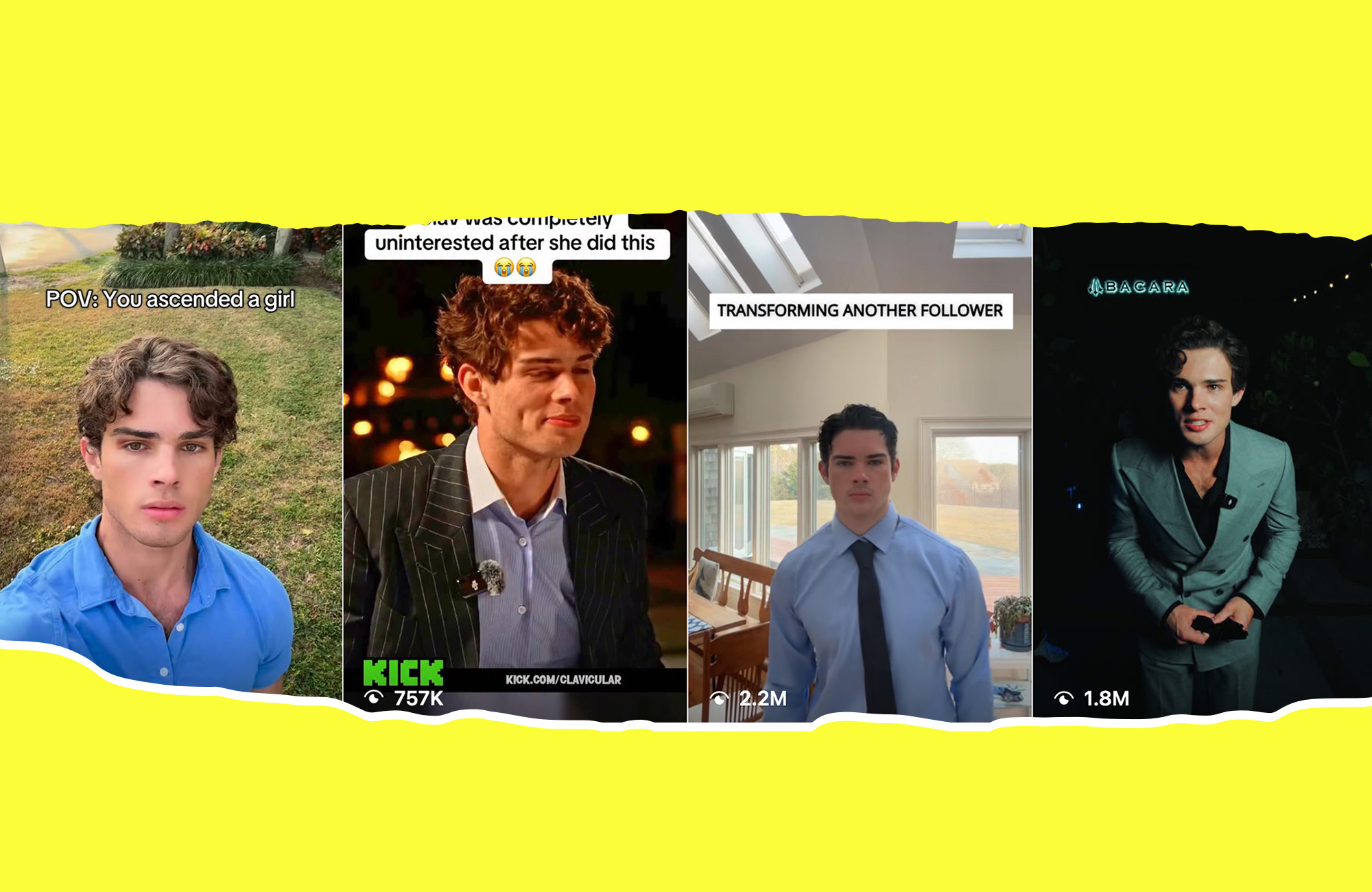 Photo illustration: The Intercept / Screenshots: Clavicular
Alain Stephens is an investigative reporter covering gun violence, arms trafficking, and federal law enforcement.
Braden Peters, better known online as Clavicular, did not become famous by offering young men discipline in any ordinary sense. He became famous by selling them “ascension”: the promise that a better face, leaner body, harsher jaw, and ruthless optimization could buy them power in a world they believe has already priced them out. In April, that sermon hit a grisly wall (or, more accurately, a floor) when Peters was hospitalized after a suspected overdose during a livestream in Miami. Bloody and bruised, he later described the hospitalization as “brutal.”
In the aftermath, Clavicular’s online presence has unraveled. YouTube recently removed his channels for repeated policy violations, including linking to prohibited sites and attempting to evade a previous ban. Despite being pushed off major platforms, he doubled down, staging a stunt trip late last month with a group of young women to Little Saint James, the private island once owned by Jeffrey Epstein.
Now, that same pattern of boundary-pushing has bled into the courts: Clavicular is facing a civil lawsuit in Florida from Aleksandra Mendoza, who alleges battery, fraud, and emotional distress, including claims that he injected her with a non-FDA-approved substance during a livestream and engaged in nonconsensual sex. Still, the streamer seems to make news almost daily, most recently for reportedly entering into a club venture in Miami with a man with ties to the Israeli mob.
None of this ongoing ordeal is some tragic footnote to the Clavicular brand. It has been him reaching his final form, stripped of filters: a young man preaching mastery through chemical self-invention, then collapsing live on camera, only to be slapped with subpoenas.
The New Prophet of Male Despair
Clavicular’s movement lives in the vocabulary of “looksmaxxing,” “hardmaxxing,” and “ascending,” a lexicon born in incel-adjacent internet forums and now being pushed into the mainstream by TikTok, Kick, and algorithmic outrage. Looksmaxxing culture didn’t emerge from nowhere; it grew out of the fringe online forums where users reduce attraction to “power, status, and looks,” obsessively rate faces, and turn self-improvement into an unyielding, almost clinical hierarchy of attractiveness.
His popularity stems from selling what he claims is the answer to a worldview born from the insular hodgepodge of pickup artists, anti-women forums, and involuntary celibacy groups — and he’s dragged it into the spotlight.
He has promoted steroid use, “bone smashing,” injecting peptides, and even using methamphetamine as part of a savage self-improvement regimen aimed mostly at young men. He has also drifted openly around Andrew Tate, Nick Fuentes, and the broader online right while insisting politics are for “jesters” (an insult in the looksmaxxing community). That juke is its own tell, because when a teenager builds an audience on hierarchy, humiliation, sexual scarcity, and racialized beauty standards, he is doing politics whether he says so or not.
Clavicular did not invent male despair, but he has certainly monetized it to his own great success.
It’s not unheard of for a young man to throw himself into the gym, practice self-discipline, embark on a rigid diet, and curate a public-facing persona. I’ve imbibed on bodybuilding culture in my own life. But Clavicular’s worldview is fueled by more than simple vanity. It is blackpill nihilism in gym clothes. The “blackpill” tells young men that the social order is fixed, intimacy is a commodified market, and the only thing left is to become more physically dominant than the next guy or accept your permanent irrelevance. In that mental framework, body maintenance becomes class warfare of the face. It is triage in a mating economy. Clavicular did not invent male despair, but he has certainly monetized it to his own great success.
Blackpilled
There is a reason this message is resonating. Clavicular’s runway to launch is an America where young men are more atomized and are worse off than their forefathers. Young American men are lonely, socially frayed, and increasingly detached from the kinds of institutions that once gave people identity outside romance and work. Gallup found that 25 percent of U.S. men ages 15 to 34 said they felt lonely “a lot” of the previous day, a higher number than young women and second in the world among our peer countries. The 2023 surgeon general’s advisory on social connection warned the country’s broader epidemic of isolation is not merely personal but structural.
Gone too is the era where men could feel like they were contributing to the community and world around them. A farmer could see his food nourishing his neighbors, a cobbler’s work lived on the feet of his peers, and a doctor literally saved the lives of his local village. These are now nothing more than oral legends passed down from baby-boomer and Gen X parents of the way it used to be.
But it is also revisionist history. This is the part too many elders refuse to admit: A lot of men were raised to expect an unearned inheritance. It was an entitlement gained at the exclusion of everyone else. They were assured that stable work, baseline social respect, and starting a family would follow if they merely stayed on the tracks as a heterosexual, yet basic, white man. But the tracks have buckled. Economist Raj Chetty’s work on mobility found that 90 percent of children born in 1940 earned more than their parents; for children born in the 1980s, that figure had fallen to around half. Meanwhile, wage growth for the top has badly outpaced the bottom 90 percent over the long arc of modern American inequality. That does not excuse reactionary politics, but it does explain why so many young men feel they were promised adulthood and handed precarity.
Misogyny is foundational to the entire right-wing project.
The modern far right, which has stepped in to fill the space the erosion of our institutions and social fabric have left behind, understands something even modern liberals tend to flatten: Misogyny is not a secondary issue. It is foundational to the entire right-wing project. Researchers have described misogyny as a gateway into far-right radicalization, and scholars who research white nationalism have shown how “Great Replacement” ideology is soaked in reproductive anxiety — the fantasy that white decline is caused not just by immigration but by women refusing their assigned breeding role. In these circles, women are not citizens. They are demographic assets and currency.
But as civil rights, reproductive rights, and immigration have expanded opportunities, life isn’t so easy for the static white-bread young men of America. They now have to bring more to the table.
It is why in Clavicular’s talk of “ascension” doesn’t just coincide with a rise in personal male beauty, but in parallel with right-wing mansophere attacks on what has been the perceived robbery of white male entitlements. It’s no shock that much of Clavicular’s vocabulary aims to diminish women, whom he publicly humiliates on his stream and reduces into self-serving chasers of status, making claims of centuries-old patriarchal domination as a societal good.
It’s an ethos that punches back at the external reality of his impressionable fanbase.
That is why Clavicular matters beyond his own cartoonish excess. He is not just some young misanthrope with a camera and a syringe. He is a clean vessel for a much older grievance: that sweeping social change has stripped certain men, especially but not exclusively cis white men, of an unearned ease their fathers and grandfathers treated as normal.
The Disappearing Man
The real theft here is spiritual. In a quixotic quest for authenticity, young men are instead being sold a playbook that they must collapse themselves into tiny, fixed archetypes: warrior, king, alpha, mogger, Chad.
Missing is heroism — not performative strength, but the harder labor of standing against cruelty.
In Clavicular’s lane, and under the auspices of social media attention, the commandment is simpler still: become beautiful or become nothing. Conspicuously absent from that script are virtues like wisdom, tenderness, stewardship, restraint, humor, and even morality.
Missing, too, is heroism — not performative strength, but the harder labor of standing against cruelty, telling the truth under pressure, protecting the vulnerable, and trying to tilt the world a few degrees toward justice.
That is why the blackpill philosophy, and broader manosphere, is antithetical to perhaps the most important tenet of true growth: courage.
It is surrender disguised as realism. It tells men to stop imagining themselves as builders of community tasked with fighting unjust systems, and instead obsess over their social ranking. It is a feudal vision of manhood with the body as castle, the whole world as an ever-present threat, and other men as rivals.
That is the real cowardice of imagination at the center of Clavicular’s rise. Not that he tells young men to exercise, clean up, or care how they present themselves. Fine. Groom yourself. Build your body. Take some responsibility. But do not confuse optimization with grit. And do not mistake a man begging his followers to buy into his despair for a leader of men.




/https://i.s3.glbimg.com/v1/AUTH_08fbf48bc0524877943fe86e43087e7a/internal_photos/bs/2026/2/d/ahXI6IRKKsgCfZJLSm1g/unnamed-1-.webp)


/https://i.s3.glbimg.com/v1/AUTH_59edd422c0c84a879bd37670ae4f538a/internal_photos/bs/2026/v/5/LEDYwDQGKH3UQaNVLzNQ/globo-canal-5-20260619-0330-frame-106870.jpeg)
:strip_icc()/i.s3.glbimg.com/v1/AUTH_59edd422c0c84a879bd37670ae4f538a/internal_photos/bs/2023/l/g/UvNZinRh2puy1SCdeg8w/cb1b14f2-970b-4f5c-a175-75a6c34ef729.jpg)
/https://i.s3.glbimg.com/v1/AUTH_08fbf48bc0524877943fe86e43087e7a/internal_photos/bs/2026/f/G/gGrBNJRwaydNM9Xc9HNQ/54966404065-a6a099d410-b.jpg)
:strip_icc()/i.s3.glbimg.com/v1/AUTH_08fbf48bc0524877943fe86e43087e7a/internal_photos/bs/2024/o/u/v2hqAIQhAxupABJOskKg/1-captura-de-tela-2024-07-19-185812-39009722.png)



:strip_icc()/i.s3.glbimg.com/v1/AUTH_08fbf48bc0524877943fe86e43087e7a/internal_photos/bs/2025/J/R/Veex9XRB6Kr6TvY1ZgLw/imagem-2025-05-21-185915249.png)

Comentários
Aproveite ao máximo as notícias fazendo login
Entrar Registro